
Freelance Hourly Rate Calculator 2026 — Find Your Real Rate in 60 Seconds
Most freelancers choose a number that seems acceptable — perhaps what a buddy charges or what they read on a job post — and go with it. The trouble is that amount has nothing to do with your actual expenses, tax bill, or what you’ll need to take home at the end of the year.
Freelance Hourly Rate Calculator 2026
Enter your income goals, working hours, and expenses below. We’ll tell you the minimum hourly rate you need to charge — and the rate you should actually quote clients.
This freelancer hourly rate calculator works backwards from what is truly important: the money in your bank account. Enter your revenue target, realistic working hours, and company expenditures, and it will tell you the minimal rate you need to charge to break even — as well as the rate you should really quote clients after factoring in a buffer for slow months and unforeseen costs.
How the Hourly Rate Calculator Formula Works
The calculator uses this core formula:
Hourly Rate = (Desired Take-Home ÷ (1 − Tax Rate) + Annual Expenses) ÷ Total Billable Hours
Then it adds your chosen profit margin on top of that base number.
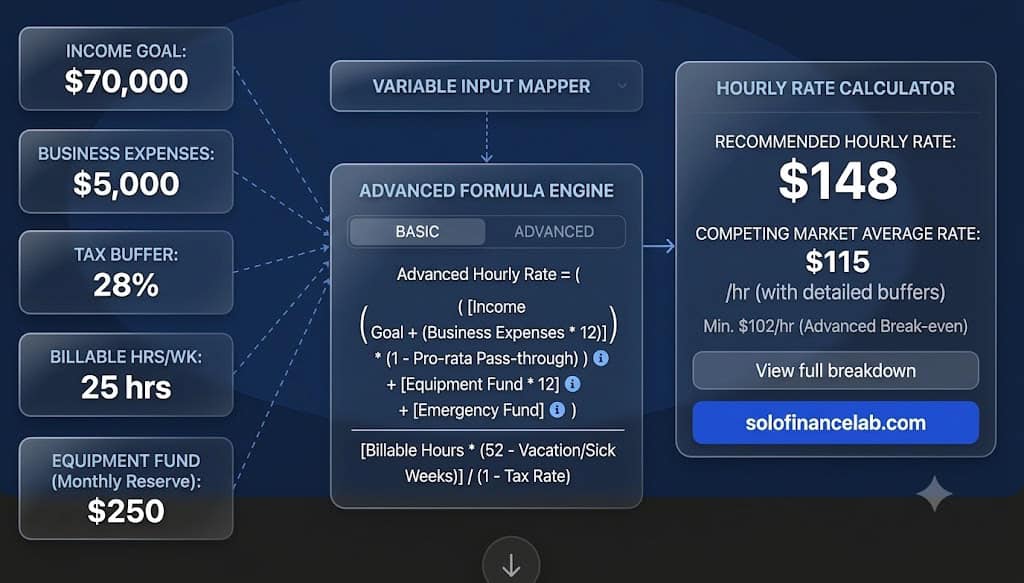
Here's a quick example. Say you want $70,000 take-home, plan to take 4 weeks off, bill 25 hours a week, spend $5,000 on business expenses, and set aside 28% for taxes:
- Weeks worked: 48
- Total billable hours: 1,200
- Gross income needed (pre-tax): ~$97,200
- Total costs including expenses: ~$102,200
- Minimum rate: ~$85/hr
- With 20% profit margin: ~$106/hr
That $106 is what you need to charge to actually hit your goal — not $70 or $75, which is where a lot of freelancers stop without doing the full math.
Why Most Freelancers Undercharge (No Use of Hourly Rate Calculator)
A $ 60-per-hour charge seems reasonable. However, if you're paying 25% self-employment tax, spending $4,000 per year on tools and software, and only billing 20 hours per week after admin and client emails take up your time, just $60 may leave you earning less than a salaried employee making $40,000.
The arithmetic is simple, but most freelancers skip it. They focus on what rivals charge or what clients appear ready to spend, rather than determining what they truly require. Undercharging occurs in the space between what seems correct and what the data show.
Your billable hours are probably lower than you realise. Administrative work, bids, invoicing, email responses, and scope revisions are not billable. Most freelancers bill for 20 to 25 hours per week, not 40. If your rate calculation assumed 40, your true effective hourly rate is nearly half of what you believe it is.
Self-employment tax is applied differently. As a 1099 contractor, you are required to pay both the employee and employer portion of Social Security and Medicare, which is 15.3% in addition to income tax before you have spent a penny. The calculator above takes this into account automatically, but it's important to understand why the gross revenue figure appears higher than your take-home pay.
What Rate Should You Actually Quote Clients?
The calculator's minimal rate is the floor – the point at which you lose money. Your quoted rate should be higher after you consider:
Your experience and expertise. A generalist and a specialist performing the same activity on paper do not mean the same thing to a client.
If you've spent years working in a specialised speciality, you might charge a premium that the formula does not account for.
Client type. Agencies usually pay less than direct customers. Enterprise clients typically pay more but move slowly. Your rate may vary based on who is on the opposite side of the contract.
Project type. Hourly pay is ideal for continuing or flexible labour. For projects, many experienced freelancers switch to fixed-price or retainer arrangements — once you know your hourly rate, you can convert it to either.
Platform fees. If you're working on Upwork, remember they take a percentage of your earnings. Factor that into your quoted rate so the platform cut doesn't eat your margin.
Take the guesswork out of freelancing. Estimate your self-employment taxes, plan your quarterly IRS payments, freelancer taxes and calculate your perfect hourly rate—all in one place.
Quarterly Tax Calculator
Figure out your quarterly IRS voucher payments easily
Self-Employment Tax Calculator
Calculate your FICA equivalent adjusted to 2026 tax standards
Freelancer Tax Calculator
Determine what to charge to cover your expenses and savings
Frequently Asked Questions
What is a good hourly rate for a freelancer in 2026?
It depends entirely on your income goals, expenses, and how many hours you actually bill. There's no universal "good" rate — the right number is the one that covers your costs and hits your take-home target. Use the calculator above to find yours based on your real situation rather than industry averages.
How many billable hours a week can a freelancer realistically expect?
Most freelancers bill between 20 and 30 hours a week once you account for admin, proposals, invoicing, and non-client time. Planning around 25 hours is a reasonable starting point for most solo freelancers — and it's better to be conservative here than to underprice because you assumed 40.
What percentage should freelancers set aside for taxes in the USA?
A safe starting buffer for US-based 1099 contractors is 25 to 30% of gross income. This covers federal income tax plus the 15.3% self-employment tax (Social Security and Medicare). Your exact number depends on your state, deductions, and total income. Use our Quarterly Tax Calculator to plan your actual IRS payments.
Should I charge hourly or by project?
Both have their place. Hourly billing works well for ongoing work or projects with unclear scope. Fixed-price works better when the deliverable is well-defined, and you're confident in your estimate. Your hourly rate is still the foundation for project pricing — multiply your rate by your estimated hours and add a buffer for scope creep.