
Tax Calculators & Money Tools Built for Freelancers
SoloFinanceLab is a set of free financial tools for freelancers: calculators and plain-English guides built for unpredictable income, quarterly taxes, and pricing decisions you make alone.
Earn $5,000 one month and $1,500 the next? Our tools help you figure out what to set aside for the IRS, what to charge per hour, and how much cushion you need for the slow months — without the jargon.
Start with our most popular tools below and take control of your freelance finances today.
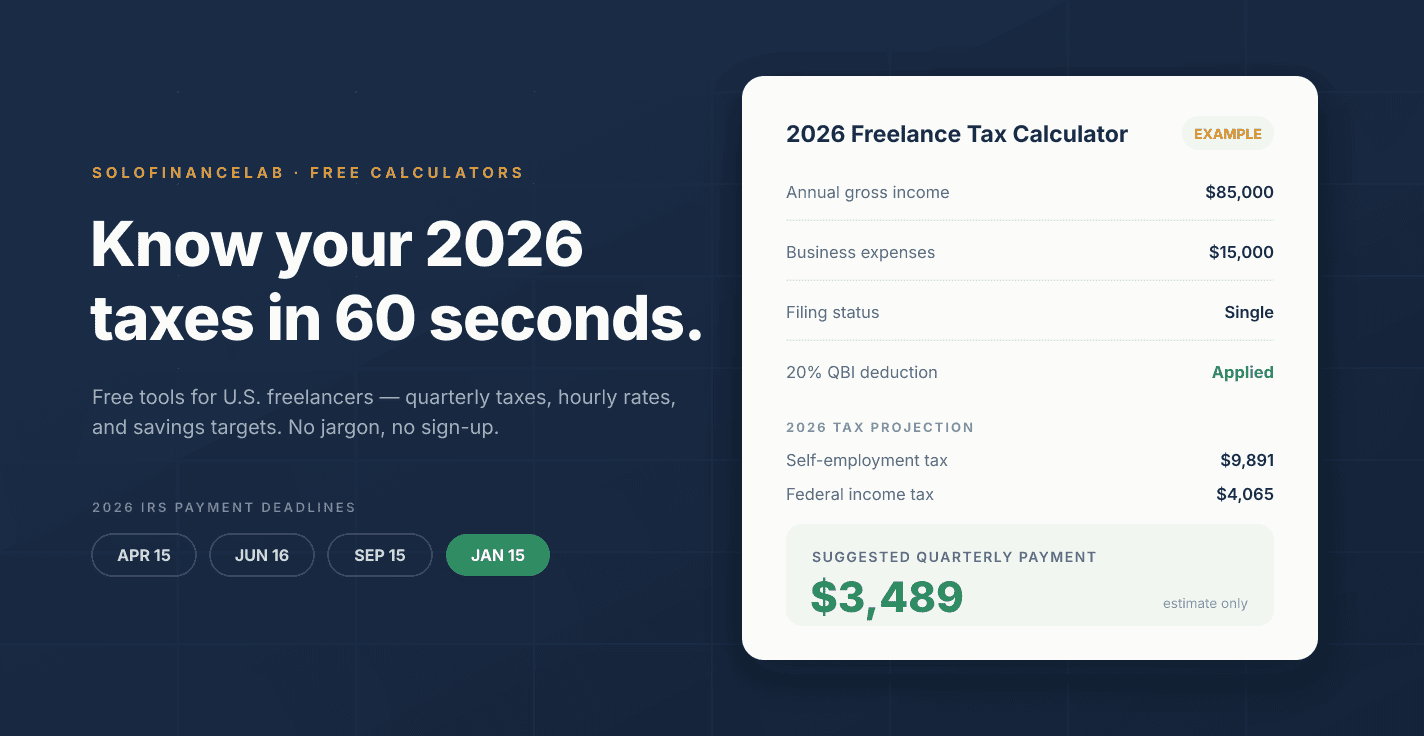
Built for Freelancers • 1099 Contractors • Creators • Self-Employed Professionals
Popular Freelancer Financial Tools
Start with the tool that matches today’s problem — each one takes under a minute and links to a guide explaining the numbers behind it.
Why freelancers need different math
Generic personal-finance advice assumes a steady paycheck with taxes already withheld. Freelance income doesn’t work that way: the IRS expects you to estimate and pay your own taxes four times a year, and a pricing mistake compounds across every invoice you send.
A self-employed designer earning $75,000 will typically need to set aside roughly 25–30% of income for federal income tax and self-employment tax combined, depending on deductions and state — money that never gets reserved automatically.
That’s the gap this site covers: quarterly tax estimates, self-employment tax math, rate-setting, and savings targets for irregular income. If you’re a freelancer, contractor, creator, or consultant managing your own income in the U.S. — full-time or as a side hustle — these tools were built for you.
Frequently Asked Questions
What are the best financial tools for freelancers?
The ones that answer a specific question fast: a quarterly tax calculator for what to send the IRS, an hourly rate calculator for what to charge, and an emergency fund calculator for how much cushion irregular income needs. All three are free on this site.
How do freelancers estimate taxes?
Take net self-employment income (after expenses), apply the 15.3% self-employment tax to 92.35% of it, then add federal income tax at your bracket. Our quarterly tax calculator does this math for you and splits it into four IRS payment deadlines.
Why is budgeting important for freelancers?
Because a $6,000 month and a $2,000 month need to fund the same fixed expenses — and the IRS bill arrives quarterly whether the month was good or not. Budgeting for the average, not the peak, is what keeps freelancers out of tax debt.
Latest Guides
-
How Much Should Freelancers Save for Taxes? (A Simple and Effective Guide)
Freelancer Save for Taxes Whether you’re new to freelancing or have been self-employed for years, one question always arises: How much of each payment should be hidden to avoid taxes?Unlike typical workers, we withhold taxes from your freelancing paychecks. The IRS expects that you pay as you earn. If you enter the wrong number, you…
-
This Is How Freelancers Can Avoid an IRS Surprise: A Guide to Freelancer Tax Planning
IRS Surprise: This Is How Freelancers Can Avoid The independence that comes with being a freelancer is amazing. You have complete control over how your business is built, including the ability to select your clients and establish your own working hours. But leaving a conventional W-2 employment entails entering a whole new relationship with the…
-
Freelance Taxes Explained in the USA: A Beginner’s Guide for 1099 Workers
Freelance taxes explained in simple terms means understanding how 1099 income, self-employment tax, quarterly payments, deductions, and IRS reporting work when taxes are not automatically withheld from your pay. If you are a freelancer, independent contractor, creator, consultant, or self-employed professional in the United States, you usually need to manage your own tax planning. This…
Official Financial Resources & Tax Authorities
Start With Our Most Popular Tool
Use our Freelance Tax Calculator to estimate taxes and plan smarter.
How we keep the numbers accurate
SoloFinanceLab is an independent project. Every tax figure on this site — brackets, rates, wage bases, and deadlines — is checked against primary IRS sources, including Form 1040-ES, the Schedule SE instructions, and the current IRS tax tables. Each tax page shows the date it was last reviewed, and we update figures when the IRS publishes changes.
Our calculators produce educational estimates, not tax advice. For filing decisions, entity elections, or anything with real money on the line, talk to a licensed tax professional.