
Smart 2026 Freelance Tax Calculator for Self-Employed Professionals
Pro-Tip
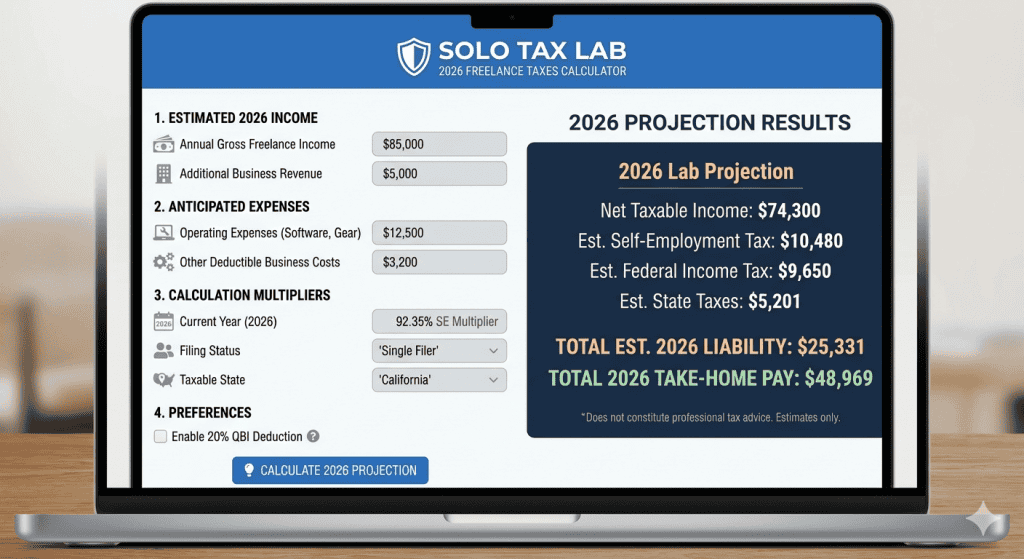
Understanding 2026 freelance taxes is important for freelancers, contractors, and self-employed professionals managing quarterly payments and self-employment income. Planning for 2026 freelance taxes requires more than just a simple spreadsheet; it requires precision logic based on the latest 2026 IRS tax updates.
Using a 2026 freelance tax calculator early prevents April surprises.
Calculation Inputs
Data is processed locally in your browser.
2026 Tax Projection
Suggested Monthly Savings
Suggested Quarterly Payment
Disclaimer: This calculator provides estimates for planning purposes only. It does not replace advice from a qualified tax professional. State taxes, credits, retirement deductions, household details, and other tax factors may change your final tax bill.
Important: This calculator currently estimates federal self-employment and income taxes only. State income taxes may apply depending on where you live.
A Guide to Understanding Your 2026 Freelance Taxes
The IRS recognizes that as a solo professional, you are both employer and employee. They apply a 92.35% multiplier to your profit before calculating the 15.3% Self-Employment tax, ensuring you aren’t taxed on the portion an employer would normally deduct.
Your income is taxed in “buckets.” You only pay higher rates—like the 24% and 32% tiers—on the dollars that fall within those specific ranges. Our calculator estimates taxes using current 2026 federal tax brackets. 🔗
Most solo earners qualify for the Qualified Business Income (QBI) deduction. Our calculator automatically applies a 20% reduction to your taxable business income right off the top, providing a more accurate tax estimate. 🔗
Example: Freelance Tax Estimate
A freelance designer earning $85,000 annually with $15,000 in deductible business expenses may owe both self-employment tax and federal income tax depending on filing status and available deductions. Using a freelance tax calculator early in the year can help estimate monthly savings targets and avoid underpayment surprises during quarterly tax deadlines.
This calculator helps estimate 2026 freelance taxes using current federal self-employment tax rates and income tax brackets.
The 30% Strategy
For maximum security, we recommend a “Safe Harbor” savings rate of 30% of your gross revenue. This ensures you have a sufficient buffer for state-level taxes and any unexpected shifts in your annual revenue.
Behind the Lab: How We Calculate 2026 Freelance Taxes
Understanding the 2026 Social Security Inflation Adjustment
For the 2026 tax year, the Social Security wage base has increased to $184,500, up from $176,100 in the previous year. This means high-earning freelancers will pay the 12.4% Social Security portion of the Self-Employment tax on an additional $8,400 of income before reaching the “cap”. Our calculator automatically identifies when your net earnings exceed this threshold and stops applying the Social Security rate, providing a precise breakdown that many generic calculators miss.
The Impact of Expanded Standard Deductions
The OBBBA has introduced a significant boost to the standard deduction for 2026 to help offset the effects of inflation. For single filers, the deduction has risen to $16,100, while married couples filing jointly now see a standard deduction of $32,200. By increasing these baseline deductions, the IRS has effectively lowered the taxable income floor for millions of solo earners, allowing more of your hard-earned revenue to remain in your pocket before federal income tax brackets even begin to apply.
New 1099 Reporting Thresholds for 2026
A major administrative shift starting in 2026 is the raising of the 1099-NEC and 1099-MISC reporting thresholds from $600 to $2,000. This change, enacted under the OBBBA, is intended to reduce paperwork for both independent contractors and the clients who hire them. While this means you may receive fewer physical forms in the mail for smaller projects, the IRS still requires you to report 100% of your business income. Our lab emphasizes this distinction to ensure your internal bookkeeping remains well-organized regardless of whether a form was issued.
The Expanded SALT Deduction and Itemizing Strategy
For freelancers in high-tax states, the 2026 tax landscape offers a temporary reprieve with the expansion of the State and Local Tax (SALT) deduction cap. Previously limited to $10,000, the new cap has been raised to $40,400 for most joint filers, with annual 1% increases scheduled through 2029. This shift may change the math on whether you should take the standard deduction or itemize your expenses. Our guidance suggests that high-income solo earners in states like New York or California re-evaluate their itemization strategy to maximize these newly available deductions.
By tracking your expenses year-round, filing your 2026 freelance taxes becomes a streamlined process rather than an April headache.
| Tax Rate | Taxable Income Range |
|---|---|
| 10% | $0 – $11,925 |
| $1,240 plus 12% of income over $12,400 | $11,926 – $48,475 |
| $5,800 plus 22% of income over $50,400 | $48,476 – $103,350 |
| $17,996 plus 24% of income over $105,700 | $103,351 – $197,300 |
| $41,024 plus 32% of income over $201,775 | $197,301 – $250,525 |
Many freelancers use tax calculators throughout the year to prepare for 2026 freelance taxes and avoid underpayment surprises.
Frequently Asked Questions
Do freelancers pay self-employment tax?
Yes. Most freelancers and self-employed professionals must pay self-employment tax in addition to federal income tax.
How much should freelancers save for taxes?
Many freelancers save between 25% and 30% of income for taxes, depending on income level, deductions, and state taxes.
Does this calculator include state taxes?
No. This calculator currently estimates federal taxes only.
Explore more freelance tax guides and calculators to improve your yearly tax planning.