
Take Control of Your 1099 Cash Flow: The Precision 2026 Quarterly Tax Calculator
Stop guessing what you owe the IRS. Estimate your precise Form 1040-ES quarterly instalments in seconds, optimise for Safe Harbour rules, and eliminate underpayment penalties for good.
SOLO TAX LAB
1099 Quarterly Estimated Tax Calculator
2026 IRS Payment Deadlines
For traditional employees, tax day happens once a year in April. But when you run your own solo business, freelance, or take on 1099 contract work, tax season rolls around four times a year.
The IRS expects self-employed professionals to pay their taxes as they earn their income. If you expect to owe $1,000 or more in taxes for the year, you are required to submit quarterly estimated tax payments using Form 1040-ES. Failing to pay enough throughout the year can result in steep underpayment interest penalties when you finally file your annual tax return.

Before you can accurately split your tax bill into four instalments, you need to know your total annual business net profit base.
If you haven't calculated that yet, use our standalone Self-Employment Tax Calculator to find your 15.3% baseline obligation first.
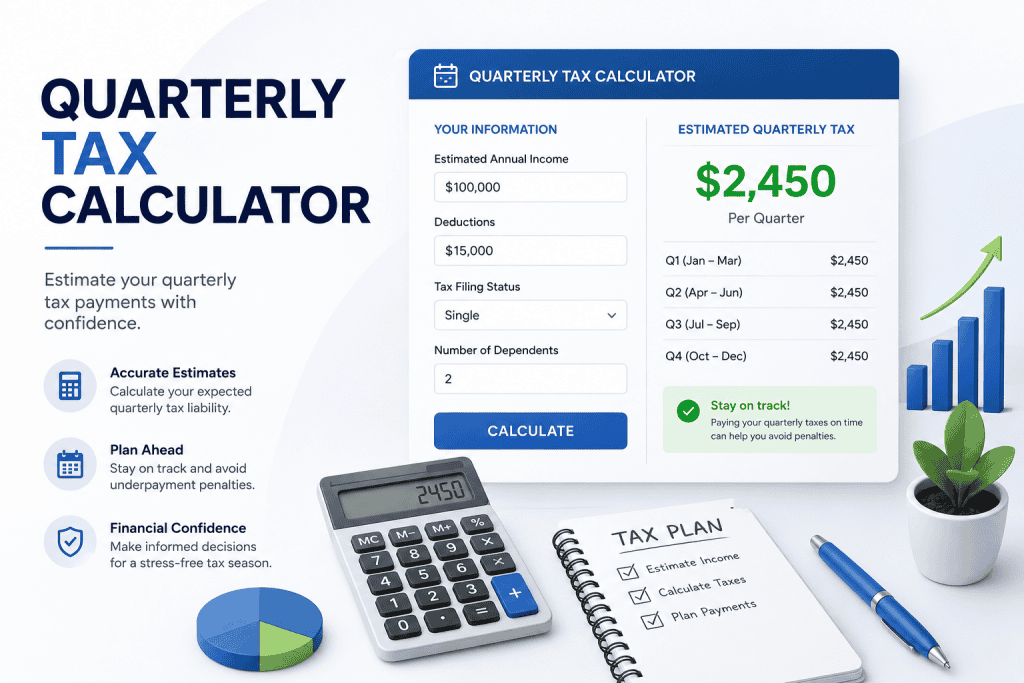
Our Quarterly Tax Calculator removes the complicated paperwork math from the equation. By looking at your projected annual gross revenue, subtracting your typical business operating costs, and breaking down your standard deductions, this tool isolates your true quarterly payload. It instantly divides your federal, state, and self-employment burdens into four clean, manageable instalment vouchers so you know exactly what to set aside each month.
The Hidden Benefit: Keeping Your Working Capital Liquid
One of the biggest mistakes solo entrepreneurs make is letting tax money sit in their main operational checking account, where it accidentally gets spent on inventory, software, or marketing. By using this calculator at the start of every quarter, you get an exact target number to transfer directly into a separate, high-yield tax savings account. This keeps your true working capital liquid, prevents business cash crunches, and ensures that when the IRS payment deadlines arrive, you can submit your voucher with a single click—zero stress required.
Make sure you don't miss the IRS filing windows
Frequently Asked Questions
Q: What is the difference between this tool and your Self-Employment Tax Calculator?
A: Our Self-Employment Tax Calculator focuses exclusively on isolating your specific 15.3% Social Security and Medicare obligations. This Quarterly Tax Calculator, however, takes that number, combines it with your progressive federal and state income tax brackets, and divides the total by four to build your actual IRS 1040-ES payment vouchers.
Q: Who is required to pay quarterly taxes?
A: Generally, if you operate as a freelancer, independent contractor, sole proprietor, or partner and you expect to owe $1,000 or more in federal taxes when you file your annual return, you are legally required to make quarterly estimated payments.
Q: What is the "Safe Harbor" rule, and how does it protect me?
A: The Safe Harbour rule is a legal tax protective cushion. The IRS will completely waive your underpayment penalty if you pay at least 100% of the total tax liability shown on your previous year's tax return (or 110% if your adjusted gross income was over $150,000). Our calculator includes a specialised Prior Year Tax Owed input box that lets you see your specific Safe Harbour payment benchmark instantly.
Q: What happens if I miss a quarterly tax deadline or underpay?
A: If you skip a payment or send less than you owe, the IRS charges an underpayment penalty fee. This penalty acts like an interest charge on the amount you should have paid from the day it was due until the day it is settled. It is always better to make a partial payment on time than to skip the deadline entirely.