

Freelance Taxes Explained in the USA: A Beginner’s Guide for 1099 Workers
Freelance taxes explained in simple terms means understanding how 1099 income, self-employment tax, quarterly payments, deductions, and IRS reporting work when taxes are not automatically withheld from your pay.
If you are a freelancer, independent contractor, creator, consultant, or self-employed professional in the United States, you usually need to manage your own tax planning. This guide breaks down freelance taxes explained for beginners so you can understand what to track, what to save, and where to start.
For more freelancer tax guides, calculators, and IRS-focused planning resources, visit the Tax Lab hub. You can also use the Freelance Tax Calculator to estimate your tax savings target.
Freelance taxes explained clearly can help beginners avoid the common mistake of treating every client payment as fully spendable income.
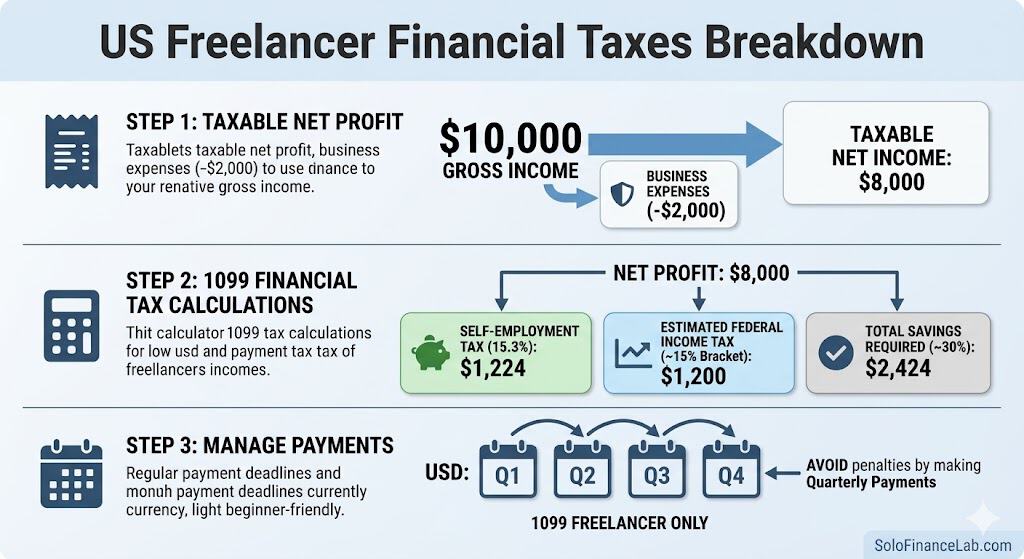
Freelance Taxes Explained: What 1099 Workers Need to Know
Freelance taxes explained simply means understanding how 1099 income is reported, which taxes apply to self-employed income, how quarterly estimated payments work, and why freelancers need to track income and expenses throughout the year.
For more tax guides, calculators, and IRS-focused resources, visit the Tax Lab hub. You can also use the Freelance Tax Calculator to estimate your tax savings target.
In this guide, we’ll cover:
- The difference between W-2 and 1099 tax status
- What taxes freelancers usually pay
- How self-employment tax works
- How quarterly estimated taxes work
- Common freelancer tax deductions
- Important tax forms and deadlines
- A simple freelance tax planning system
Freelance taxes explained in simple terms means knowing who handles withholding, which taxes apply to 1099 income, how quarterly payments work, and why freelancers need to track income and expenses throughout the year.
The Difference Between W-2 and 1099 Tax Status
The biggest tax difference between a W-2 employee and a 1099 freelancer is withholding. A W-2 employee usually has federal income tax, Social Security tax, and Medicare tax withheld from each paycheck. The employer also pays part of the payroll tax.
A 1099 freelancer is different. Clients usually pay the full invoice amount without withholding taxes. That feels good when money arrives, but it also means you must set aside part of that payment for taxes yourself.
For example, if a client pays you $3,000 for a project, that full amount may land in your bank account. But the full $3,000 is not necessarily spendable income. You may need to reserve part of it for federal income tax, self-employment tax, and state tax.
| Feature | W-2 Employee | 1099 Freelancer |
| Tax withholding | Usually automatic | Usually self-managed |
| Income reporting | Form W-2 | Form 1099-NEC or other income records |
| Payroll taxes | Shared with employer | Paid through self-employment tax |
| Tax planning | Mostly handled through payroll | Requires active planning |
What Taxes Do Freelancers Pay?
Most freelancers in the United States need to think about three main types of taxes: federal income tax, self-employment tax, and state income tax. The exact amount depends on income, expenses, filing status, deductions, and location.
Federal Income Tax
Federal income tax is based on your taxable income. Freelancers report business income and business expenses. After deductions, the remaining profit generally becomes part of your taxable income.
Your federal income tax rate depends on your filing status and tax bracket. Freelancers with higher taxable income generally pay higher marginal tax rates, while those with lower taxable income may owe less federal income tax.
Self-Employment Tax
Self-employment tax covers Social Security and Medicare taxes for people who work for themselves. This is one of the biggest surprises for new freelancers because it is separate from regular federal income tax.
State Income Tax
State income tax depends on where you live and work. Some states do not have a state income tax, while others have flat or progressive tax systems. Freelancers should check their state’s department of revenue website for specific rules and deadlines.
How Self-Employment Tax Works
The self-employment tax rate is 15.3%. It includes 12.4% for Social Security and 2.9% for Medicare. This applies because freelancers are treated as both the employer and the employee for Social Security and Medicare purposes.
The IRS generally requires self-employed individuals to file an income tax return if net earnings from self-employment are $400 or more. That does not mean you only pay tax on amounts above $400. It means $400 is an important filing threshold for self-employment income.
For a quick estimate, use the Freelance Tax Calculator. It can help estimate self-employment tax, federal income tax, estimated state tax, and suggested tax savings targets.
| Tax Type | Purpose | General Rate |
| Social Security | Retirement, survivor, and disability benefits | 12.4% |
| Medicare | Hospital insurance | 2.9% |
| Total self-employment tax | Social Security + Medicare | 15.3% |
Note: High earners may face additional Medicare tax, and Social Security tax has an annual wage base limit. Always verify current rules with the IRS or a qualified tax professional.
With freelance taxes explained step by step, quarterly payments become easier to understand because you can connect income, expenses, savings, and IRS deadlines in one simple system.
How Quarterly Estimated Taxes Work
Since freelancers often do not have withholding on client payments, they may need to calculate their estimated quarterly tax with our quarterly estimated tax calculator. These payments usually cover federal income tax and self-employment tax. State-estimated payments may also be required, depending on where you live.
The IRS provides estimated tax guidance and allows taxpayers to pay estimated taxes online, by mail with Form 1040-ES, by phone, or through IRS payment systems.
Simple Quarterly Tax Planning Example
Suppose a freelance writer earns $20,000 in net profit during the first quarter. Instead of spending the full amount, the freelancer may choose to set aside 25% to 30% for taxes. That creates a tax reserve of $5,000 to $6,000 before the quarterly payment deadline.
This is only a planning example. The actual amount may be higher or lower depending on deductions, state taxes, total annual income, filing status, and other factors.
Common Freelancer Tax Deductions
Freelancers can usually deduct ordinary and necessary business expenses. A deduction reduces taxable business profit, which may lower the amount of income subject to tax.
Common freelance deductions may include:
- Software subscriptions used for client work
- Business internet and phone expenses
- Home office expenses, if eligible
- Business equipment such as laptops, cameras, or tools
- Professional courses, training, or certifications
- Payment processing fees
- Business insurance
- Accounting or bookkeeping software
- Contractor payments
- Business travel and mileage, when properly documented
Do not guess or invent deductions. Keep receipts, invoices, bank records, and notes explaining the business purpose. Clean records make tax filing easier and reduce stress if questions come up later.
Important Tax Forms for Freelancers
Freelancers may deal with several tax forms depending on income type and business structure. The most common forms include Form 1099-NEC, Schedule C, Schedule SE, and Form 1040-ES.
Form 1099-NEC
Clients may send Form 1099-NEC when they pay a freelancer for nonemployee compensation. Even if you do not receive a 1099 form, you are still generally responsible for reporting taxable business income.
Schedule C
Many sole proprietors use Schedule C to report business income and business expenses. This form helps calculate net business profit or loss.
Schedule SE
Schedule SE is used to calculate self-employment tax. This is where Social Security and Medicare tax for self-employed income is generally calculated.
Form 1040-ES
Form 1040-ES helps taxpayers estimate and pay quarterly taxes. Freelancers often use it as part of a quarterly tax planning routine.
A Simple Freelance Tax Planning System
You do not need a complicated system to start managing freelance taxes. A simple structure can help you stay organized and avoid last-minute panic.
Step 1: Track Every Payment
Record every client payment, even if the client does not send a tax form. Your own records matter because tax forms may not capture every dollar of income.
Step 2: Track Business Expenses Monthly
Set a monthly routine to organize receipts, invoices, subscriptions, and bank transactions. Waiting until tax season makes mistakes more likely.
Step 3: Save a Percentage of Each Payment
Many freelancers set aside 25% to 30% of net income as a starting tax savings range. Higher-income freelancers or freelancers in high-tax states may need a larger buffer. Lower-income freelancers with strong deductions may need less.
Step 4: Estimate Quarterly Payments
Use your income, expenses, and tax savings balance to estimate quarterly tax payments. The Freelance Tax Calculator can help you create a rough estimate, but final decisions should be reviewed with a qualified tax professional when needed.
Step 5: Review After Filing
After filing your tax return, compare your actual tax bill with what you saved during the year. If you saved too little, increase your savings percentage next year. If you saved too much, you may be able to adjust your tax reserve while keeping a safe buffer.
Common Freelancer Tax Mistakes to Avoid
Freelance tax mistakes are usually caused by poor tracking, weak planning, or misunderstanding how 1099 income works. Here are some common mistakes to avoid:
- Spending the full client payment: Part of each payment may need to be saved for taxes.
- Ignoring quarterly taxes: Waiting until April can create a large bill and possible penalties.
- Mixing personal and business expenses: This makes deductions harder to prove and records harder to manage.
- Forgetting state taxes: State income tax may apply even if you already planned for federal taxes.
- Relying only on 1099 forms: You may still need to report income even if no 1099 form arrives.
- Not saving receipts: Poor records can cause missed deductions or filing problems.
Official IRS Resources for 1099 Workers
For official information, freelancers should review IRS resources directly. Start with the IRS Self-Employed Individuals Tax Center, the IRS Estimated Taxes page, and the IRS Self-Employment Tax guidance.
These official sources are important because tax rules can change, and your situation may involve details that a general guide cannot fully address.
Once you have freelance taxes explained in plain language, the next step is building a routine: track income monthly, save for taxes consistently, review deductions, and estimate payments before deadlines arrive.
Frequently Asked Questions
Do freelancers pay more taxes than employees?
Freelancers may feel like they pay more because they are responsible for both income tax and self-employment tax. Employees also pay Social Security and Medicare taxes, but part of the payroll tax is handled by the employer.
Do I need to pay taxes if I do not receive a 1099?
Yes, income may still be taxable even if no 1099 form is issued. Freelancers should track all client payments and report income accurately.
How much should freelancers save for taxes?
A common starting range is 25% to 30% of net freelance income. The right amount depends on your total income, deductions, filing status, state taxes, and other factors. Read our guide on how much freelancers should save for taxes for a deeper breakdown.
What is self-employment tax?
Self-employment tax is the Social Security and Medicare tax paid by people who work for themselves. It is separate from federal income tax.
Can the Freelance Tax Calculator replace a CPA?
No. The calculator provides estimates for planning purposes only. It does not replace a CPA, enrolled agent, attorney, or qualified tax professional.
Final Thoughts
Freelance taxes in the USA become easier to manage when you understand the basics: 1099 income is usually not withheld, self-employment tax applies to many freelancers, and estimated tax payments may be needed throughout the year.
The best starting point is a simple system: track income, track expenses, save a tax percentage from each payment, and review your numbers quarterly. This keeps tax planning manageable even when freelance income changes from month to month.
Next step: visit the Tax Lab for more freelance tax guides, or use the Freelance Tax Calculator to estimate your tax savings target.
Disclaimer: This article is for educational purposes only and does not provide tax, legal, accounting, or financial advice. Tax rules can change, and your situation may require professional guidance.